by cr_threeillusions | Mar 4, 2012 | Blog
I love getting questions or challenges from readers and I will respond to as many of them as I can here.
Last night I was talking to a reader who happens to be my mother. Her feeling was that we don’t yet know everything there is to know about how the brain works and that one day we might find something that justifies a belief in free will.
While I totally agree that we have much to learn about the brain, it seems far-fetched to think that any new discoveries will negate the fact that the brain is made of chemicals. And chemicals, as we all know, obey certain laws – the Laws of Chemistry. And chemicals always function according to causality. Add two atoms of hydrogen to one atom of oxygen under the right conditions and you will always end up with a molecule of water.
So whatever we learn about the brain, it will always be true that our thoughts and decisions are electro-chemical events inside the brain. And these events will – MUST – be the result of causal laws. So if they are causal, they cannot be ‘free’. Fight it all you want, but your thoughts, actions and decisions are 100% the result of causality.
Now, of course, this does NOT mean that your brain cannot learn and change and, therefore, that means how you react in certain situations might change over time. The brain is always changing. But no matter how your brain and behavior changes over time, you will still never have free will. As you grow new neurons and new connections between existing neurons, those new neurons will continue to operate according to the causal laws of chemistry.
Finally, the idea that we may learn new things about how the brain works in the future and that this might justify our belief in free will is a self-defeating idea in the first place. If you don’t know right now exactly HOW you create thoughts and decisions, then you cannot claim to be in control of those events. And if you aren’t in control, then you don’t have free will.
by cr_threeillusions | Feb 15, 2012 | Blog
Great video!
[youtube http://www.youtube.com/watch?v=iRIcbsRXQ0o]
by cr_threeillusions | Jan 15, 2012 | Blog
USA Today has this excellent article by Jerry Coyne, Professor of Evolution at the University of Chicago. Prof. Coyne’s explanation mirrors my own, however he is much more elegant. His conclusion:
There’s not much downside to abandoning the notion of free will. It’s impossible, anyway, to act as though we don’t have it: you’ll pretend to choose your New Year’s resolutions, and the laws of physics will determine whether you keep them. And there are two upsides. The first is realizing the great wonder and mystery of our evolved brains, and contemplating the notion that things like consciousness, free choice, and even the idea of “me” are but convincing illusions fashioned by natural selection. Further, by losing free will we gain empathy, for we realize that in the end all of us, whether Bernie Madoffs or Nelson Mandelas, are victims of circumstance — of the genes we’re bequeathed and the environments we encounter. With that under our belts, we can go about building a kinder world.
Of course, I’d argue that the benefits are much greater – the absence of fear, guilt, anxiety, anger and worry.
by cr_threeillusions | Dec 17, 2011 | Blog
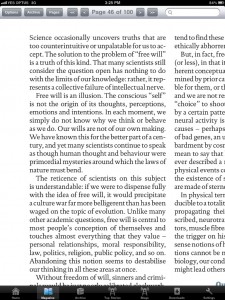
Just in case you didn’t believe me, neuroscientist and author Sam Harris has written an excellent piece on free will in the Christmas edition of New Statesmen magazine (which has been edited by Richard Dawkins).
Here’s a screenshot of my iPad copy. It’s worth purchasing the app so you can read the whole thing, it’s only $2.99.
by cr_threeillusions | Dec 14, 2011 | Blog
Here’s a great list of quotes about free will via Bill Schloendorn.
While they are all great, this one is my favourite:
Charles Darwin: “…one doubts existence of free will [because] every action determined by heredity, constitution, example of others or teaching of others.” “This view should teach one profound humility, one deserves no credit for anything…nor ought one to blame others.” From Darwin’s notebooks, quoted in Robert Wright, The Moral Animal, pp. 349-50.