I’ve heard a few stories lately about people with brain injuries and how they might affect their “free will”. On today’s show I talk about those stories and think about them from a Three Illusions perspective.
Want to subscribe to the series? You can find us on iTunes, or click the “Subscribe” links below this post and you’ll get what you need. If you know how to manually subscribe to a podcast, use this feed. If you want to discuss the show or the book, you can join our Facebook page, our forum, ping me on Twitter, or shoot me an email.
In this latest experiment, researchers have removed the human interference in deciding whether or not the system is “open” or “closed”. Without trying to explain the science (because it’s way over my head), the results are fascinating. Essentially the article suggests that photons (and, by extension, all other sub-atomic particles) are NEITHER particles NOR waves. Instead, the concepts of “particles” and “waves” are ideas that we are placing on quantum particles because our brains aren’t able to understand what is truly going on. Here’s Anil’s conclusion:
It’s a notion that takes us straight back into Plato’s cave, says Ionicioiu. In the ancient Greek philosopher’s allegory, prisoners shackled in a cave see only shadows of objects cast onto a cave wall, never the object itself. A cylinder, for example, might be seen as a rectangle or a circle, or anything in between. Something similar is happening with the basic building blocks of reality. “Sometimes the photon looks like a wave, sometimes like a particle, or like anything in between,” says Ionicioiu. In reality, though, it is none of these things. What it is, though, we do not have the words or the concepts to express.
If physicists come to the conclusion that the nature of reality is something stranger than they can even conceive or have concepts to express – and you are made of that reality – what makes you think you understand what or who you truly are?
Imagine you had magic glasses you could put on that allowed you to see the world around you at the atomic level. What would you see? For a start, the outlines of your body, where it starts and stops, wouldn’t be so easy to determine. Every second, MILLIONS of atoms are leaving your body, shed from your skin and via your breath. Of course, every second your body is also ABSORBING new particles, via your breath, your food, photons entering your eyes, etc. Wouldn’t you see a huge, swirling mass of activity? The air around you, the furniture, other people, inanimate objects – would all be a mass of swirling atomic and sub-atomic activity. Surely your concept of what you are would change dramatically. Just because our senses have evolved to perceive just a minute fraction of the information that is available, should we base our identity on anything but the full picture?
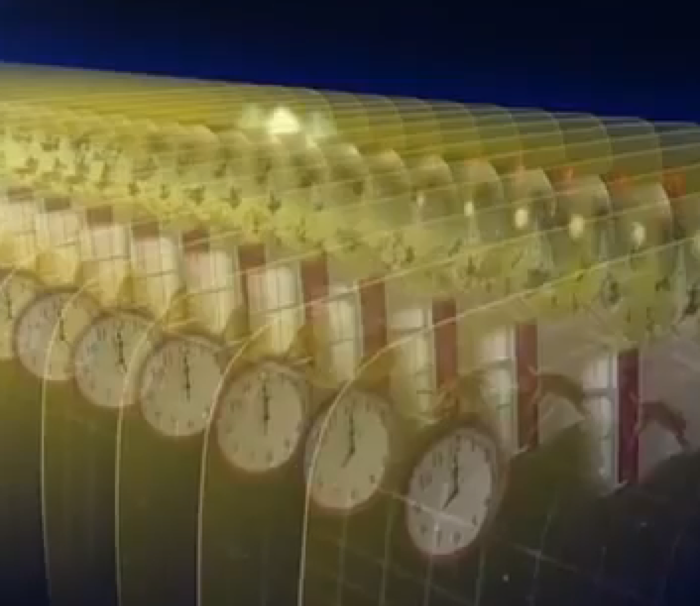
Brian Greene explains why space and time are part of a single continuum and why that means that everything that will ever happen HAS ALREADY HAPPENED somewhere in space-time.
As I try to explain in the book, this means it is pointless to worry about what might happen in the future. If it HAS ALREADY HAPPENED, what’s the point of worrying about it? All we can do it wait to catch up to the future to see what did/will happen.
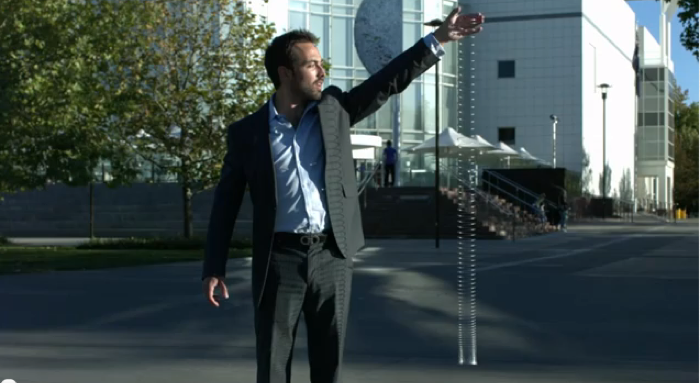
The answer is – I have no idea! However the below video and the RadioLab podcast “What A Slinky Knows” bring up some interesting philosophical issues about time, information and the nature of our perceptions.
What happens to the bottom rung of a slinky when you let go of the top rung?