by cr_threeillusions | Sep 3, 2012 | Blog, Enlightenment, Guideposts
Once you get it, there is no going back.
Someone suggested to me recently that some people ‘have the enlightenment experience’ but then they go back to living the old way.
To me this seems unlikely. The ‘enlightenment experience’, if you want to call it that, is a one way street. Once you realize that you are not, never have been and never will be an individual entity as you had always assumed, it fundamentally changes your life experience. It is like waking up from the Matrix – once you know, you know. It’s a fundamental shift in your thinking. It’s like finding out one of your parents has died. You don’t forget and try to call them the next day or a few months later. You might retain certain mental habits. My dad died 11 years ago and I still sometimes have the thought that I’d like to talk to him, but, when I do, my brain immediately reminds me that he is dead.
The same is true of knowing that you are not an individual. Certain habits of thinking about yourself as an individual might remain, after all, they are hard wired into your brain, but if you’ve had ‘the experience’, then whenever those thought arise, they will immediately be countered by the new information.
by cr_threeillusions | Mar 22, 2012 | Blog
A hot topic for several thousand years, the question of whether free will exists may never be settled to everyone’s satisfaction. But in a series of new articles for the Chronicles of Higher Education, six academics from diverse fields offer fresh perspectives from the standpoints of modern neuroscience and philosophy. Ultimately, they voted 4-2 in favor of the position that free will is merely an illusion.
The four scientists on the panel denied the existence of free will, arguing that human behavior is governed by the brain, which is itself controlled by each person’s genetic blueprint built upon by his or her life experiences. Meanwhile, the two philosophers cast the dissenting votes, arguing that free will is perfectly compatible with the discoveries of neuroscience.
(link)
by cr_threeillusions | Mar 4, 2012 | Blog
I love getting questions or challenges from readers and I will respond to as many of them as I can here.
Last night I was talking to a reader who happens to be my mother. Her feeling was that we don’t yet know everything there is to know about how the brain works and that one day we might find something that justifies a belief in free will.
While I totally agree that we have much to learn about the brain, it seems far-fetched to think that any new discoveries will negate the fact that the brain is made of chemicals. And chemicals, as we all know, obey certain laws – the Laws of Chemistry. And chemicals always function according to causality. Add two atoms of hydrogen to one atom of oxygen under the right conditions and you will always end up with a molecule of water.
So whatever we learn about the brain, it will always be true that our thoughts and decisions are electro-chemical events inside the brain. And these events will – MUST – be the result of causal laws. So if they are causal, they cannot be ‘free’. Fight it all you want, but your thoughts, actions and decisions are 100% the result of causality.
Now, of course, this does NOT mean that your brain cannot learn and change and, therefore, that means how you react in certain situations might change over time. The brain is always changing. But no matter how your brain and behavior changes over time, you will still never have free will. As you grow new neurons and new connections between existing neurons, those new neurons will continue to operate according to the causal laws of chemistry.
Finally, the idea that we may learn new things about how the brain works in the future and that this might justify our belief in free will is a self-defeating idea in the first place. If you don’t know right now exactly HOW you create thoughts and decisions, then you cannot claim to be in control of those events. And if you aren’t in control, then you don’t have free will.
by cr_threeillusions | Feb 19, 2012 | Blog
You can now get a print version of The Three Illusions via Lulu. Worldwide shipping.
by cr_threeillusions | Feb 17, 2012 | Blog
Phil Plaitt has written a fascinating article on the latest thinking about dark matter.
Dark matter, to re-interpret Obi Wan Kenobi, surrounds us and penetrates us. It binds the galaxy together. At least that’s what a new scientific study seems to show. Dark matter appears to stretch well beyond the visible limits of galaxies, flowing through and filling even the vast, previously-thought empty space between galaxies. The researchers, led by Shogo Masaki of Nogoya University, used computer simulations to model how dark matter behaves over time as it helps form galaxies, and found that while it’s concentrated in and around galaxies, it doesn’t fade away into nothing with distance. It does get thinner, but still exists to a measurable degree well outside of galaxies.
There is a strong temptation to find a way to tie dark matter into the concept of our identity. However, as I pointed out in the book, all attempts to define ourselves as “this thing” or “that thing” seem to end in failure. And yet we exist. The conclusions is that we must be the fundamental underlying substrate if the universe – or, we might as well say, “I am the universe”. This would automatically include all forms of matter and energy, including dark matter. Everything in the universe (that we know about) is made up of bosons, thermions and perhaps, now, we add axions?
by cr_threeillusions | Feb 15, 2012 | Blog
Great video!
[youtube http://www.youtube.com/watch?v=iRIcbsRXQ0o]
by cr_threeillusions | Jan 15, 2012 | Blog
USA Today has this excellent article by Jerry Coyne, Professor of Evolution at the University of Chicago. Prof. Coyne’s explanation mirrors my own, however he is much more elegant. His conclusion:
There’s not much downside to abandoning the notion of free will. It’s impossible, anyway, to act as though we don’t have it: you’ll pretend to choose your New Year’s resolutions, and the laws of physics will determine whether you keep them. And there are two upsides. The first is realizing the great wonder and mystery of our evolved brains, and contemplating the notion that things like consciousness, free choice, and even the idea of “me” are but convincing illusions fashioned by natural selection. Further, by losing free will we gain empathy, for we realize that in the end all of us, whether Bernie Madoffs or Nelson Mandelas, are victims of circumstance — of the genes we’re bequeathed and the environments we encounter. With that under our belts, we can go about building a kinder world.
Of course, I’d argue that the benefits are much greater – the absence of fear, guilt, anxiety, anger and worry.
![A Brain Cell vs the Universe]()
by cr_threeillusions | Jan 11, 2012 | Blog
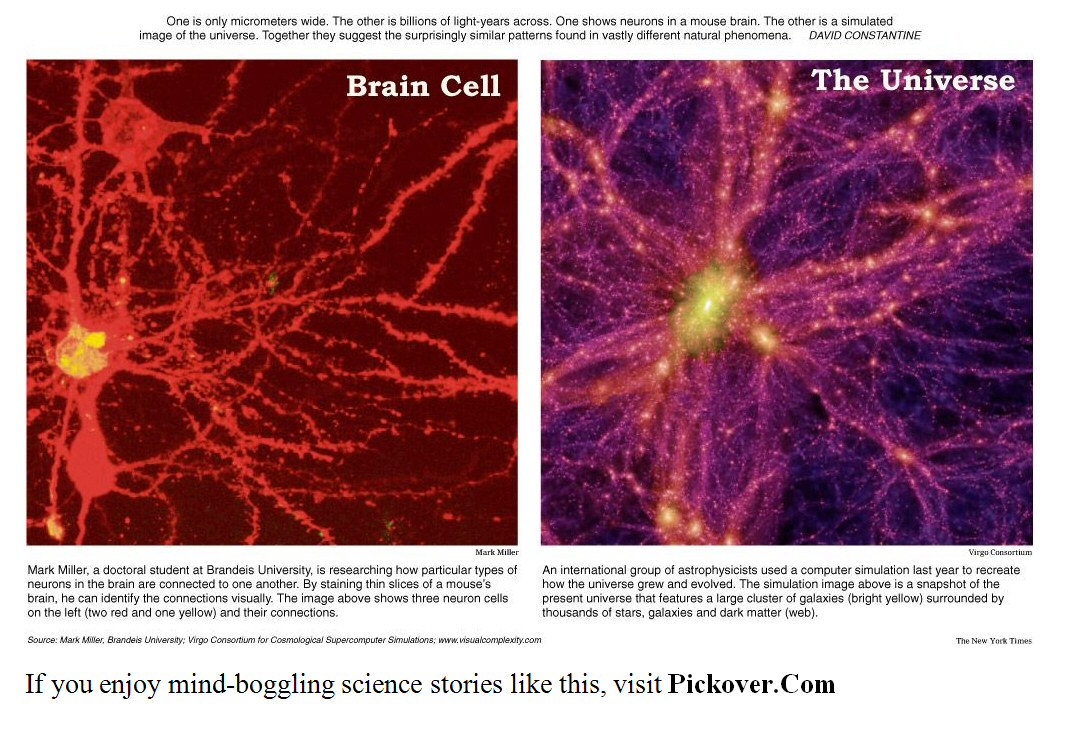
Compare the picture of a brain cell on the left with the computer model of the current universe on the right. What does it tell us?
Nothing really, except that the same patterns can be found across the universe.
It’s a nice picture though. 🙂 H/T to Bill Schloendorn.
by cr_threeillusions | Dec 17, 2011 | Blog
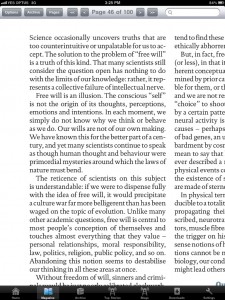
Just in case you didn’t believe me, neuroscientist and author Sam Harris has written an excellent piece on free will in the Christmas edition of New Statesmen magazine (which has been edited by Richard Dawkins).
Here’s a screenshot of my iPad copy. It’s worth purchasing the app so you can read the whole thing, it’s only $2.99.
by cr_threeillusions | Dec 15, 2011 | Blog
Thanks to everyone who purchased the book on launch day and especially to those of you who Tweeted or Facebooked it. There’s been some lovely feedback. If you get a chance, please drop a quick review on the Amazon page. It looks a bit barren up there at the moment.
I’m thinking about doing an audio version of the book and then perhaps, if I get any questions about the content of the book, a weekly podcast where I can answer questions, have people live on the show to ask questions, etc. What do you think?